Reviewed · AMMAN TOURS
Départ Garanti Francophone (GIR) SAMEDI – SAMEDI
Jordan packs a lot into one week. This 8-day French-speaking circuit links Roman ruins, desert castles, Petra, Wadi Rum, and the Dead Sea with airport transfers, meals, hotels, and a permanent guide during sightseeing days. I especially like the mix of major sights and less familiar stops, from Qasr Amra’s early Islamic frescoes to Ajloun Castle. I also like that the price of $875 includes entrance fees, six lunches, six dinners, seven breakfasts, and a local 4×4 ride in Wadi Rum.
The main consideration is the pace. You cover much of Jordan by road, and some days include several long visits before another hotel change. The advertised group maximum of 150 is also worth noting, since a group that large could feel less personal even with a French-speaking guide.
This tour suits you if you want Jordan’s essential sights arranged for you, with French-language support and little need to manage transport. It is less suitable if you prefer slow mornings, independent wandering, or boutique travel in a small group.
In This Review
- The Jordan highlights that matter most
- What $875 buys you in Jordan
- Arrival in Amman: an easy first evening
- Amman’s Citadel and Roman Theatre
- Jordan’s eastern desert castles
- Jerash and Ajloun: one of the tour’s best days
- Madaba, Mount Nebo, and Kerak on the Kings’ Highway
- Petra deserves the full day
- Little Petra and a night in Wadi Rum
- The Dead Sea closes the trip gently
- Transport, group size, and daily comfort
- Who should book this Jordan circuit?
- Final verdict: a strong first taste of Jordan
- FAQ
- How long is the Jordan tour?
- Where does the tour begin?
- What time is the stated start?
- Is a French-speaking guide included?
- Which meals are included?
- Are entrance fees included?
- Is the Wadi Rum 4×4 ride included?
- Does the tour include a night in Bedouin tents?
- Are flights included?
- Is the Petra carriage ride included?
The Jordan highlights that matter most
- A full Petra day: Six hours gives you time to see more than the famous Treasury and appreciate the scale of the Nabataean city.
- A strong Roman pairing: Amman’s Roman Theatre and the vast ruins of Jerash show two very different sides of Roman Jordan.
- Desert castles beyond the standard route: Qasr Amra, Qasr Al Harranah, and Azraq add early Islamic and frontier history to the trip.
- A real Wadi Rum experience: The program includes about 90 minutes in a local Bedouin 4×4 and one night under Bedouin tents.
- French-speaking support: A permanent French-speaking guide is included during the sightseeing days. Abdelrhman Bawaneh and Firas are named in the available feedback as especially friendly and engaging guides.
- A useful price package: Transport, admission fees, most meals, hotels, airport assistance, and the desert excursion are all included.
What $875 buys you in Jordan
At $875 per person, this is not simply a sightseeing bus with a few tickets attached. The package covers modern, air-conditioned transport sized to the group, airport reception and departure help, hotel stays, a French-speaking guide during the touring days, listed admission fees, and the Bedouin 4×4 excursion.
Food is also built into the price. You receive seven breakfasts, six lunches, and six dinners. Drinks are not included, and you should budget separately for water, soft drinks, coffee, and any other beverages. One bottle of water is provided on the bus during visits.
The value is strongest if you plan to visit all these places anyway. Petra alone requires a substantial entry fee, and the circuit adds Jerash, Amman’s Citadel and Roman Theatre, Ajloun Castle, Madaba, Mount Nebo, Kerak, the desert castles, Wadi Rum, and the Dead Sea. You also avoid arranging intercity transport across a country where the major sights are spread far apart.
The tradeoff is limited control. You follow a fixed Saturday to Saturday schedule, and the route is designed to deliver a lot of Jordan rather than offer long free periods. A single-room supplement applies if you need an extra room, and flights, insurance, tips, drinks, and a Petra carriage ride are extra.
A few more trips worth weighing up before you book
- Amman: Petra, Wadi Rum, and Dead Sea 2-Day Tour
★ 4.9 · 1,173 reviews - 2-Day Tour: Petra, Wadi Rum, and Dead Sea from Amman
★ 5.0 · 1,141 reviews - From Amman: Petra & Wadi Rum Private or group Day Tour
★ 4.9 · 750 reviews
Arrival in Amman: an easy first evening
Day one begins at Queen Alia International Airport, where the group receives assistance before customs and transfers to the hotel in Amman. Dinner and an overnight stay are included.
There is no scheduled sightseeing on arrival day, which is sensible after a flight. Still, the stated meeting time is 8:00 am, so you should check how that applies to your arrival flight before booking. The program is built around airport pickup, but the practical start of your sightseeing depends on when you land.
Amman is a city of pale limestone buildings spread over hills between the eastern desert and the Jordan Valley. You get only a short introduction to it on this trip, with the main city visits coming the next day.
Amman’s Citadel and Roman Theatre
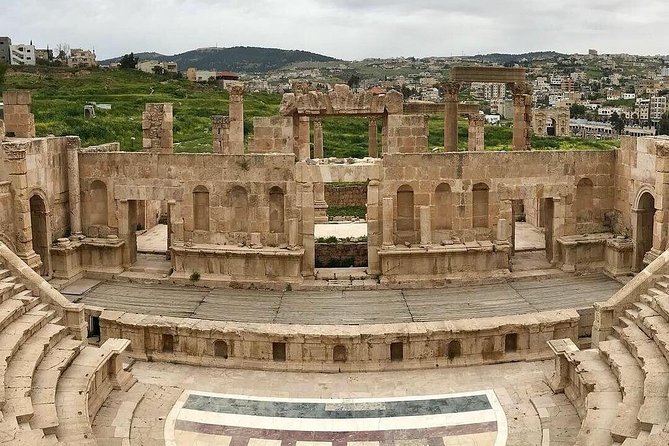
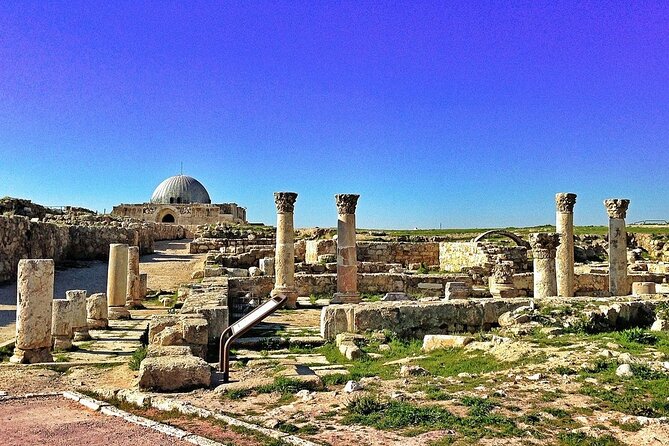
The second morning begins at the Citadel, also called Jabal al Qalaa. This hill gives you a broad view across Amman’s cream-colored buildings and puts the city’s ancient remains above the modern streets.
The site combines Roman ruins, a palace, and Jordan’s national archaeological museum. The scheduled visit lasts about an hour, enough for an overview and photographs, though not enough for an unhurried museum visit if you like to read every display.
Next comes the Roman Theatre, the best-preserved major monument of Roman Philadelphia. It once held about 6,000 people, while a nearby odeon held roughly 500. The theatre is impressive partly because of its size and partly because it remains tied to the present city, rather than sitting alone in an empty archaeological zone.
Allow for stairs and uneven stone at both sites. The moderate fitness requirement is important here, and it becomes more important later at Petra, Jerash, and the castles.
Jordan’s eastern desert castles
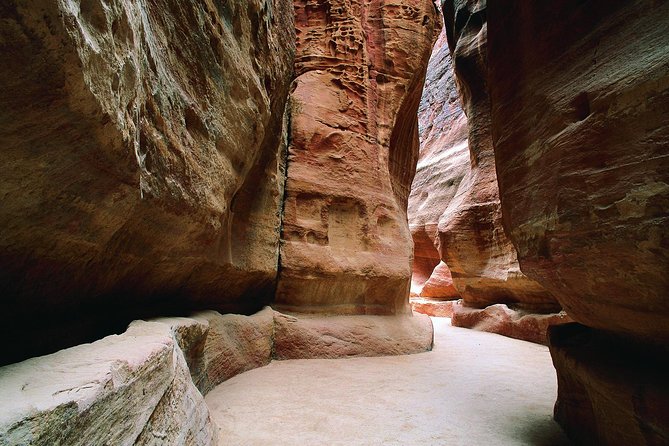
The afternoon leaves Amman for three very different sites: Qasr Al Harranah, Quseir Amra, and Qasr Al Azraq. These stops make the route more interesting than a standard capital and Petra itinerary.
Qasr Al Harranah sits about 55 kilometers from Amman. Its solid form may point to a military purpose, although the stables also suggest that it could have served as a caravan stop. You will not get a single neat answer from the architecture, which is part of the appeal.
Quseir Amra, about 26 kilometers southwest of Azraq, is a small early eighth-century desert castle built by Caliph Walid I. Its rounded lines and pale stone suit the dry setting, but the real reason to visit is its unusually well-preserved interior decoration. Walid I was associated with hunting, poetry, and courtly pleasures, and the building reflects a very different side of Jordan’s past from the Roman monuments.
Qasr Al Azraq was heavily damaged by the 1927 earthquake, yet the remaining fortress still has a strong presence. An inscription above the main entrance dates its renovation to the thirteenth century, and a mosque sits in the middle of the courtyard.
Each stop receives about an hour. That keeps the day moving, but it also means you should expect a guided look rather than extended independent exploration. Admission is included at Harranah and Quseir Amra. Azraq is listed with no admission charge.
A completely different kind of day out around Amman:
- From Amman: Petra and Wadi rum Full day Tour
★ 5.0 · 538 reviews - 2-Day Petra, Wadi Rum and Dead Sea Tour from Amman
★ 5.0 · 467 reviews - 3-Day Private Tour from Amman: Petra, Wadi Rum, Dana, Aqaba, and Dead Sea
★ 5.0 · 425 reviews - Petra Full-Day Private Tour from Amman
★ 4.9 · 392 reviews
Jerash and Ajloun: one of the tour’s best days
Jerash is one of the strongest stops on the entire route. About 45 kilometers from Amman, this ancient city is widely regarded as one of the best-preserved Roman provincial cities in the Near East.
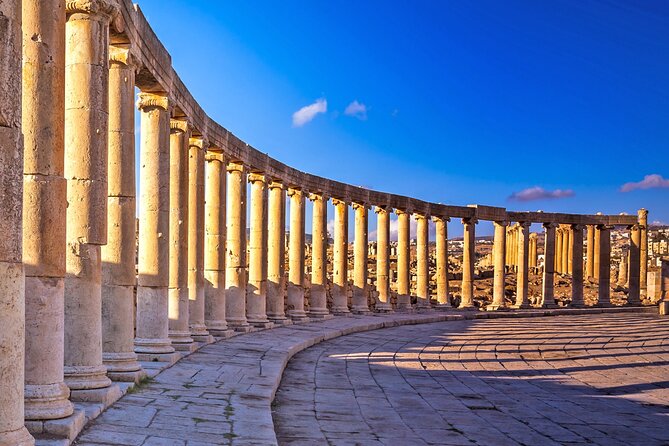
The ruins include paved, colonnaded streets, large temples, theatres, and formal public spaces. Much of the city was hidden under sand for centuries and then restored over roughly 70 years. The warm pink and orange limestone changes color in the early and late light, so your three-hour visit should feel substantial rather than rushed.
Jerash rewards comfortable shoes and a willingness to walk. The site is broad, and its scale only becomes clear when you move from one open area to the next. Your guide can also help connect the columns and street plan to the city that once functioned here, instead of leaving you with a collection of attractive ruins.
After lunch, the tour continues to Ajloun Castle. Built in the twelfth century during the time of Saladin, the fortress guarded the region, helped control local iron mines, and blocked Crusader movement toward Jerusalem.
The castle sits high on a mountain and provides fine views across the Jordan Valley. The two-hour stop is long enough to examine its defensive structure, but the climb and uneven surfaces again make the moderate fitness requirement real. You return to Amman for dinner and another overnight stay.
Madaba, Mount Nebo, and Kerak on the Kings’ Highway
Day four follows the Kings’ Highway toward Madaba, Mount Nebo, and Kerak. It is one of the most varied days, but it also involves another long road section and several historical layers.
Madaba is known for its mosaics, particularly the sixth-century map in Saint George’s Church. The mosaic once measured about 25 meters by 5 meters and used around two million small stone pieces. It maps the Byzantine Near East, including places that matter to the region’s religious geography.
The church visit lasts about two hours. Take time to look closely at the individual tesserae, since the work is easy to underestimate when seen from a distance. Madaba itself is also a useful reminder that Jordan’s Christian history is not limited to a few isolated pilgrimage sites.
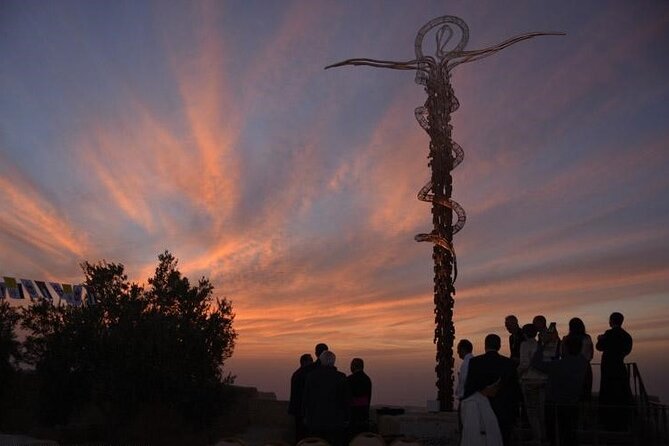
Mount Nebo rises to about 840 meters and is traditionally associated with the place where Moses viewed the Promised Land before his death. It became an important pilgrimage site in the early Christian period.
The site’s value is both religious and visual. From the summit, you can look toward the Jordan Valley and the area around Jericho, depending on conditions. The two-hour visit gives your guide time to explain the biblical and Christian importance of the site without reducing it to a quick photo stop.
The final major stop is Kerak. Its fortress grew from the Crusader period and changed hands after the defeat at Hattin and the Muslim conquest of Jerusalem. The castle’s history includes Baldwin I, Foulques of Anjou, Payen the Butler, Renaud de Châtillon, and Saladin.
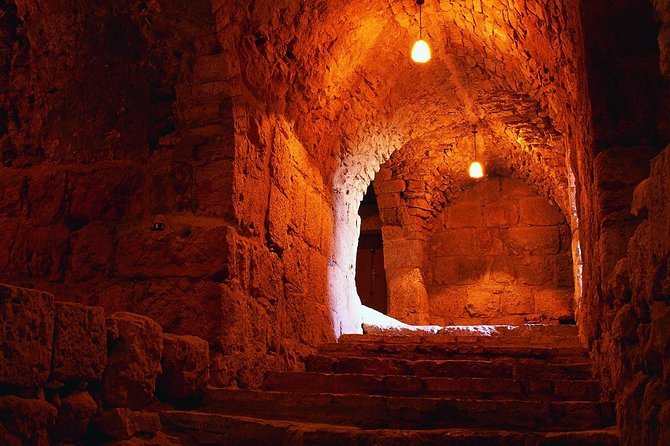
The two-hour visit is best approached as an exploration of thick walls, passages, and defensive spaces rather than a polished museum experience. A small archaeological museum is included in the stop. Bring patience for dim corridors and uneven flooring, and stay close enough to hear your guide.
Petra deserves the full day
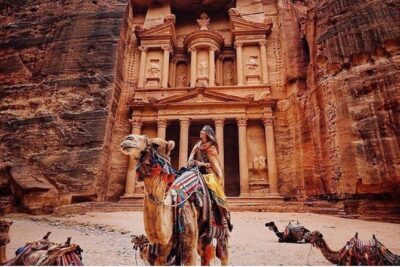
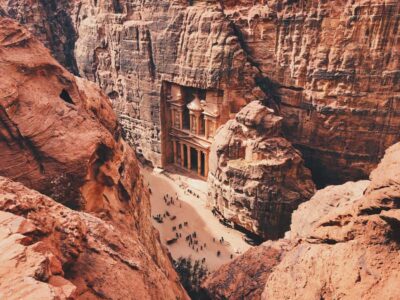
Day five is devoted to Petra, and this is one of the tour’s biggest strengths. Six hours gives you a much better chance to appreciate the site than a short stop squeezed between other attractions.
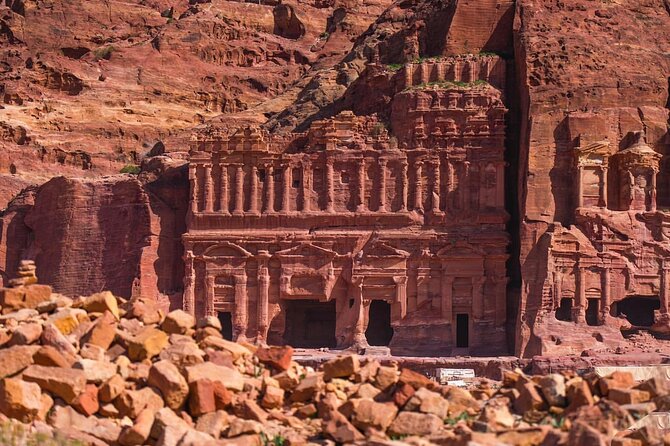
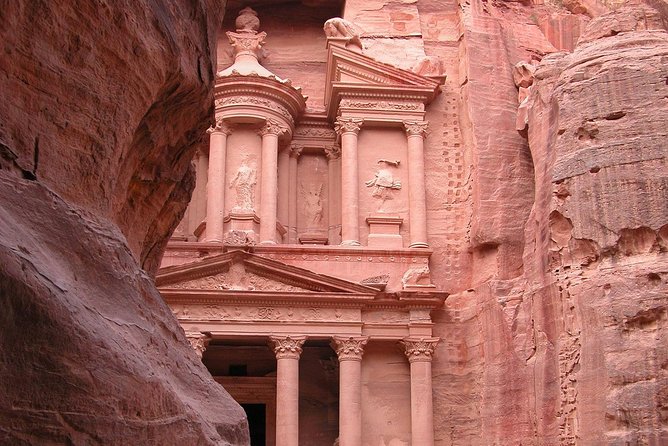
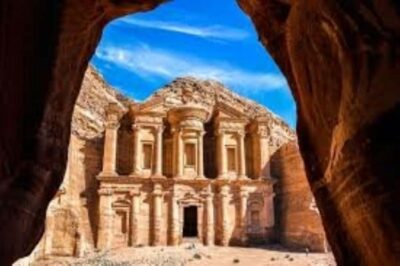
Petra is not just the Treasury. The ancient Nabataean city extends through narrow passages, valleys, carved facades, and broad open areas. Its famous rose-colored stone is only one part of the experience. The scale of the site, the engineering, and the way buildings appear from the rock make the visit memorable even if you have seen photographs for years.
You should expect a great deal of walking on uneven ground. Comfortable shoes, sun protection, and water matter. The program includes lunch and dinner, but drinks and the optional horse-drawn carriage ride cost extra.
The itinerary allows a full day but does not spell out every section you will visit. Your guide’s pacing will matter. Abdelrhman Bawaneh is praised for being passionate, involved, and interesting, while Firas is described as very friendly. A strong guide can add much here by explaining how the city fits together and helping you use your six hours well.
Little Petra and a night in Wadi Rum
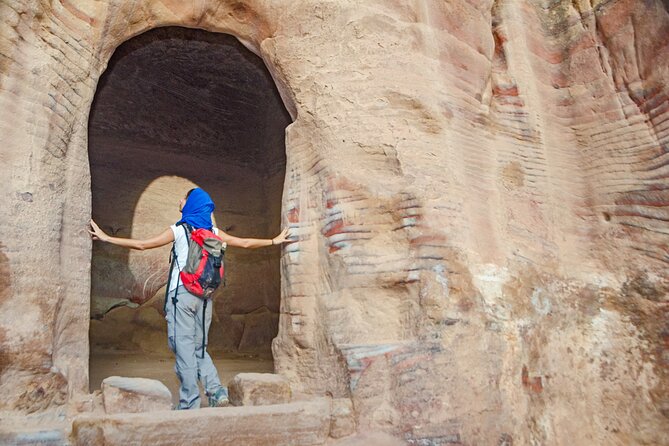
The next morning begins with Little Petra before continuing to Wadi Rum. Little Petra offers a quieter introduction to Nabataean rock-cut architecture and works well as a transition from Petra to the desert.
Wadi Rum is a very different kind of sight. Its cliffs, peaks, and valleys were formed by nature rather than carved into a city. The area is linked with the Arab Revolt and with the film Lawrence of Arabia, but the setting itself is the main attraction: open desert, dramatic rock formations, and wide silence.
A local Bedouin 4×4 takes you through the protected area for about an hour and a half. This is not a luxury vehicle excursion, and the word local matters. You are getting a practical desert ride that adds movement and scale to the visit.
Lunch is served at a Bedouin camp, followed by dinner and an overnight stay in Bedouin tents. Camp conditions are naturally less predictable than a hotel, so pack with that change in comfort level in mind. The overnight stay is a valuable part of the program because you do not simply pass through Wadi Rum during daylight.
The Dead Sea closes the trip gently
After breakfast at the camp, you travel along the Araba route to the Dead Sea. At about 1,306 feet below sea level, it is the lowest point on Earth and one of Jordan’s most unusual natural settings.
The program includes lunch and free time for swimming. The high salt content makes floating easy, but you should take care around the water and avoid getting it in your eyes or on cuts. The tour information does not specify the exact bathing facility or hotel arrangement, so confirm those details before departure if the Dead Sea portion is especially important to you.
This final day provides a useful change of pace after Petra, castles, and desert roads. The mountains to the east and the hills toward Jerusalem create a striking setting, while the water and mineral mud have been valued for therapeutic use for centuries. The itinerary gives you six hours here, making it more than a quick roadside photograph.
Transport, group size, and daily comfort
The trip uses modern, air-conditioned transport, with the vehicle selected according to group size. That should make the long transfers easier, especially on the route from Amman through Madaba and Kerak toward Petra and Wadi Rum.
The maximum group size is listed as 150 people. That is a significant number. It can help keep the price down, but it may also mean several vehicles, slower loading, and less time for personal questions. Ask how the French-speaking groups are divided and who will guide your specific vehicle.
Hotels, breakfasts, lunches, and dinners are included, but the exact hotel names and categories are not provided. One available account praises the comfortable hotels and good food, while another describes the meals as delicious. I would still ask for the hotel list before paying, especially if room quality or location matters to you.
The guides are a major part of the experience. The program promises a permanent French-speaking guide during sightseeing days, and the names Abdelrhman Bawaneh and Firas are associated with warm, engaging service. If you need French commentary throughout the trip, confirm that the guide remains with your group on every touring day.
Who should book this Jordan circuit?
I would choose this tour if you want to see the main Jordanian sights without arranging transfers, tickets, meals, and desert transport yourself. It is especially useful for French-speaking visitors who want a guide available throughout the sightseeing portion.
It also suits first-time visitors who prefer a clear route. Amman, Jerash, the eastern castles, Madaba, Mount Nebo, Kerak, Petra, Little Petra, Wadi Rum, and the Dead Sea form a strong first look at Jordan.
I would hesitate if you want a small group, flexible meal times, or long stretches without a schedule. The eight days are full, some walking is demanding, and a maximum of 150 people could affect the atmosphere. You should also add money for drinks, tips, insurance, flights, and any single-room supplement.
The cancellation terms are fairly forgiving: you can receive a full refund if you cancel at least 24 hours before the local start time. Changes or cancellations inside that window are not accepted for a refund.
Final verdict: a strong first taste of Jordan
This is a well-rounded Jordan route with real variety. The full Petra day, the Bedouin tent night in Wadi Rum, the Roman remains at Jerash, and the less expected desert castles give the trip more substance than a simple capital to Petra package.
The price is reasonable for what is included, especially with meals, admissions, airport transfers, transport, a French-speaking guide, and the 4×4 excursion bundled together. I would book it if convenience and coverage matter more to you than privacy and free time.
FAQ
How long is the Jordan tour?
The tour lasts approximately eight days, running from Saturday to Saturday.
Where does the tour begin?
It begins with pickup at Queen Alia International Airport in Amman, Jordan.
What time is the stated start?
The stated start time is 8:00 am.
Is a French-speaking guide included?
Yes. A permanent French-speaking guide is included during the sightseeing days.
Which meals are included?
The package includes seven breakfasts, six lunches, and six dinners.
Are entrance fees included?
Yes. The entrance fees specifically mentioned in the program are included. Qasr Al Azraq is listed with free admission.
Is the Wadi Rum 4×4 ride included?
Yes. A local Bedouin 4×4 excursion lasting about one and a half hours is included.
Does the tour include a night in Bedouin tents?
Yes. The Wadi Rum portion includes dinner and an overnight stay in Bedouin tents.
Are flights included?
No. Airfare is not included.
Is the Petra carriage ride included?
No. The optional carriage ride at Petra costs extra.
Just added around Amman
- Amman Airport Private Round-Trip Transfer to Amman★ 5.0 · 3 reviews
- Petra Full-Day Private Tour from Amman or Airport★ 5.0 · 3 reviews
- Full Day Amman Old and New Private City Tour★ 5.0 · 3 reviews
- From Amman :Full day Dead Sea and Ma’in Hot spring tour★ 5.0 · 3 reviews
- Dead Sea Full Day Tour including Lunch★ 5.0 · 3 reviews
- Jordan’s Gems: Tour from Amman to Karak Castle & Dead Sea★ 5.0 · 3 reviews
- 2-Night Private Jordan Gem Tour: Petra, Wadi Rum, and Aqaba from Amman★ 5.0 · 3 reviews
- Full-Days Tours Petra from Amman★ 5.0 · 3 reviews
Amman Tours, compared.
2-Day Tour: Petra, Wadi Rum, and Dead Sea from Amman
Read our review →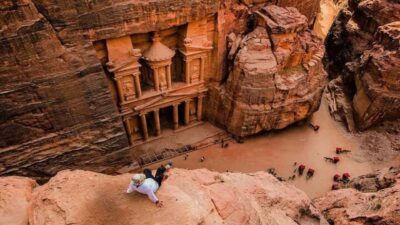
2-Day Petra, Wadi Rum and Dead Sea Tour from Amman
Read our review →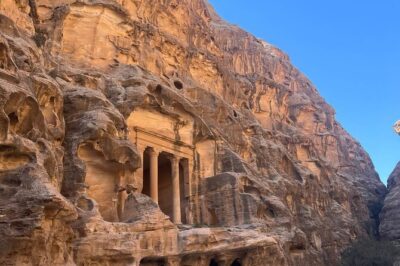
3-Day Private Tour from Amman: Petra, Wadi Rum, Dana, Aqaba, and Dead Sea
Read our review →