
Reviewed · JERASH & AJLOUN TOURS
Full Day Tour in Jerash and Amman City
Ancient ruins meet everyday Amman. This six to seven-hour private tour gives you a useful first look at Jordan’s capital, then takes you north to Jerash, one of the finest Roman sites in the region. I like the combination of Amman’s Citadel and Roman Theatre, followed by the wide streets and temples of Jerash. I also like having hotel pickup, private transport, bottled water, and WiFi included.
The main consideration is cost at $79 per person, since admission tickets and a local guide are extra. The price makes better sense for a small group, especially because one shared guide fee can be divided among four people. Without a guide, Jerash can feel confusing because signs are limited.
In This Review
- Key points to know before booking
- Why this Amman and Jerash combination works
- The Citadel: Amman’s hilltop story
- The Roman Theatre and the view from the upper seats
- King Abdullah Mosque and its blue dome
- Jerash: two hours among Roman streets and temples
- Transport, timing, and the private format
- What the $79 price really buys
- Who should choose this day out?
- Booking, cancellation, and final advice
- FAQ
- How long does the tour last?
- Is hotel pickup included?
- Is this a private tour?
- What type of vehicle is provided?
- Is an English-speaking driver included?
- Is a local guide included?
- How much time is planned at Jerash?
- Are admission tickets included?
- Is King Abdullah Mosque open to non-Muslim visitors?
- Can I cancel for a full refund?
Key points to know before booking
- Jerash gets the longest visit: You have about two hours to explore its temples, theaters, plazas, and colonnaded avenues.
- This is a private tour: Only your own group takes part, which allows more control than a large coach excursion.
- A local guide costs extra: A guide at Jerash is not included, with quoted guidance fees of JD20 in the tour details and JD30 shared among four people in one booking note.
- Amman’s Blue Mosque welcomes non-Muslim visitors: King Abdullah Mosque is the only mosque in Amman listed as openly welcoming non-Muslim visitors.
- Admission tickets are not included: Bring extra money for the Citadel, Roman Theatre, mosque, and Jerash.
- Pickup and drop-off are included in Amman: The air-conditioned vehicle is a practical comfort, especially during warmer months.
Why this Amman and Jerash combination works
Amman and Jerash show two very different sides of Jordan. Amman is a living city, built around hills, streets, markets, and neighborhoods. Jerash is an archaeological site where the Roman city plan remains unusually easy to read.
I like the order of the day because you begin with Amman’s most important sights before heading to Jerash. The Citadel explains the city’s long past, while the Roman Theatre brings you closer to the Roman period. King Abdullah Mosque then adds a modern religious landmark before the tour moves to the ancient city north of Amman.
The private format matters. You are not joining a large group, so your party has the vehicle to itself and can ask the English-speaking driver questions along the way. The driver is not described as a local guide, so you should not expect full archaeological commentary at every stop. For that, plan to hire a guide at Jerash.
The timing is fairly tight but workable. Six to seven hours is enough for the main sights, though you will not have unlimited time for Amman’s downtown streets and markets. If your priority is a slow city walk, this tour may feel brisk. If you want the major highlights in one day, it is efficient.
More Jerash and Ajloun day trips:
- Full-Day Tour: Umm Qais, Jerash, and Ajloun from Amman
★ 5.0 · 162 reviews - Private Tour of Ajlun and Jerash
★ 5.0 · 130 reviews - Jerash, Ajloun, Umm Qais Day Trip
★ 5.0 · 99 reviews
The Citadel: Amman’s hilltop story
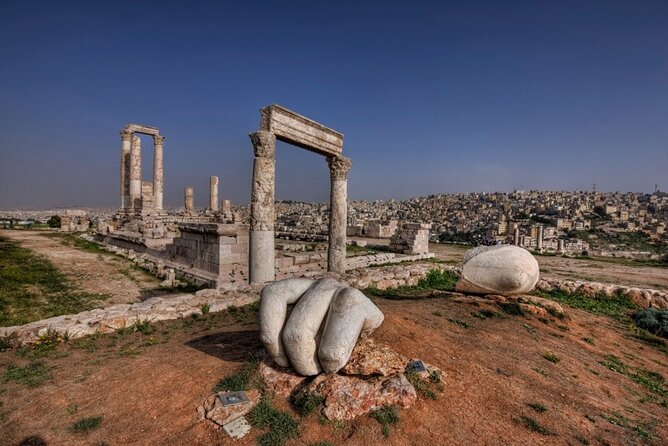
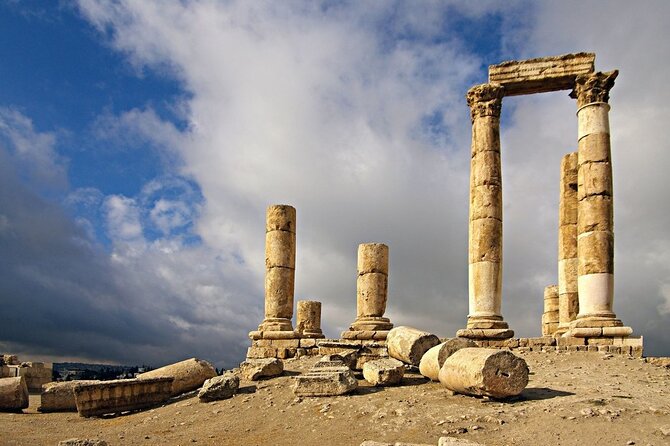
The Citadel is the right place to begin understanding Amman. Evidence of occupation reaches back to the Neolithic period, and the hill was fortified during the Bronze Age around 1800 BCE. It later became the capital of the Kingdom of Ammon sometime after 1200 BCE.
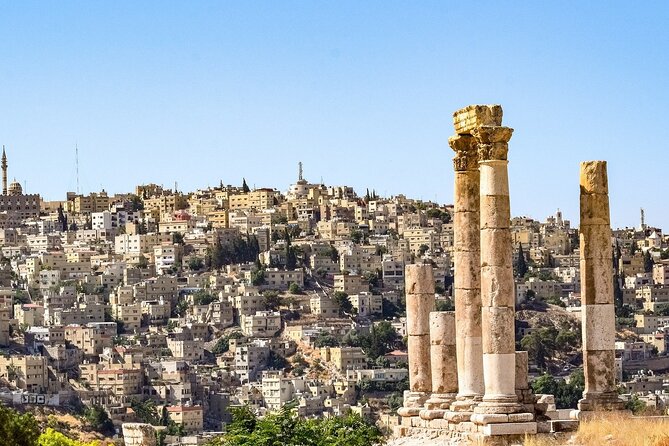
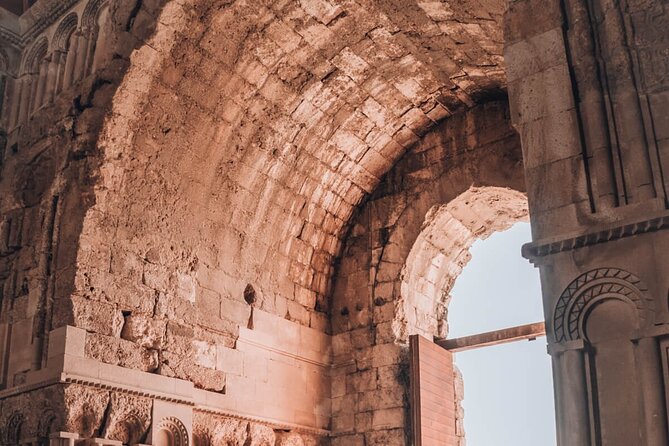
That long sequence is what makes the site more than a Roman stop. The hill passed through Assyrian, Babylonian, Ptolemaic, Seleucid, Roman, Byzantine, and Umayyad control. Each period left traces, and the Citadel gives you a compact view of several civilizations in one location.
You have about one hour here. That is enough to see the principal remains and take in the setting, but the site rewards attention. I would use this stop to get your bearings, look across Amman’s hills, and listen closely to any explanation your driver provides.
The Citadel also helps explain the character of modern Amman. The ancient hill sits above a city that later declined and was largely abandoned until the late nineteenth century, when settlement began again. The site is considered one of the world’s oldest continuously inhabited places, though much of its visible remains come from later periods.
Admission is not included, so budget for a separate ticket. Wear shoes suited to uneven archaeological ground, and remember that the hill can be exposed to sun. The one-hour visit is useful, but you may want more time if ancient history is your main interest.
The Roman Theatre and the view from the upper seats
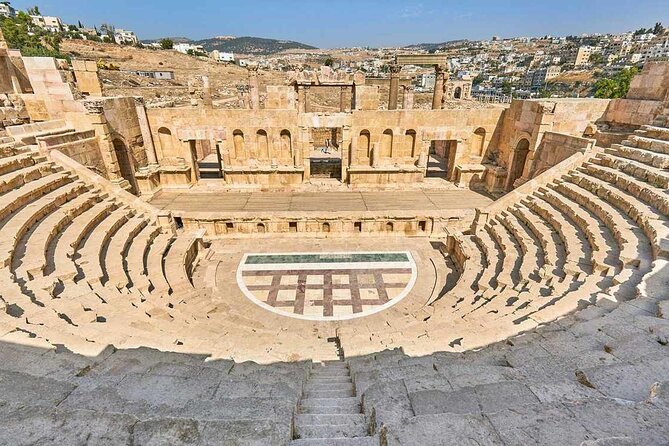
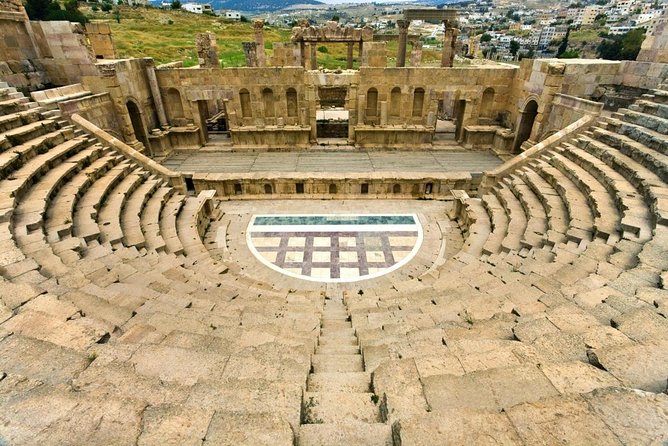
The Roman Theatre is Amman’s most obvious Roman monument. Cut into the northern side of a hill, it could hold about 6,000 people and has been restored in a way that makes its original scale easy to grasp.
You have about 30 minutes here. That is enough to walk through the seating area, look down toward the stage, and climb toward the upper tiers for a broader view. The theatre is a strong photography stop, especially in the morning when the light is softer. The upper seats can also offer excellent views shortly before sunset, although this tour’s schedule may not place you there at that time.
The theatre is physically demanding in a small way. The steps are steep in places, and the upper rows are worth reaching only if you are comfortable climbing them. Take your time rather than treating this as a quick photo stop.
Like the Citadel, admission is extra. The two sites are close in the story of ancient Amman, but they feel different. The Citadel is an archaeological hill with layers from many periods. The theatre is a focused Roman structure that immediately shows how public entertainment and civic life once worked.
King Abdullah Mosque and its blue dome
King Abdullah Mosque gives the tour a change of pace. Completed in 1989 as a memorial by the late King Hussein to his grandfather, the mosque is recognized by its large blue dome and octagonal prayer hall.
The main dome measures 35 meters across and carries Quranic inscriptions. The prayer hall can hold up to 7,000 worshippers, with another 3,000 people in the courtyard. There is also a women’s section for 500 worshippers and a smaller royal enclosure.
You have about 30 minutes here. That is enough for a short visit and a look at the architecture, rather than a full religious or cultural program. It is especially useful for visitors who want to see an active place of worship as part of their Amman day.
This is the only mosque in Amman described as openly welcoming non-Muslim visitors. Dress and behavior should still be respectful, as this remains a functioning religious site. Admission is not included, so confirm the current entrance arrangement with the operator or driver.
The mosque adds balance to the day. Without it, the Amman portion would focus almost entirely on ancient remains. Here you see a modern Jordanian landmark that is still tied to public and religious life.
A few more trips worth weighing up before you book
- From Amman: Petra and Wadi rum Full day Tour
★ 5.0 · 538 reviews - Petra Full-Day Private Tour from Amman
★ 4.9 · 392 reviews - Amman Petra Full-Day Trip
★ 5.0 · 270 reviews - From Amman : Full day tour to Petra
★ 5.0 · 250 reviews
Jerash: two hours among Roman streets and temples
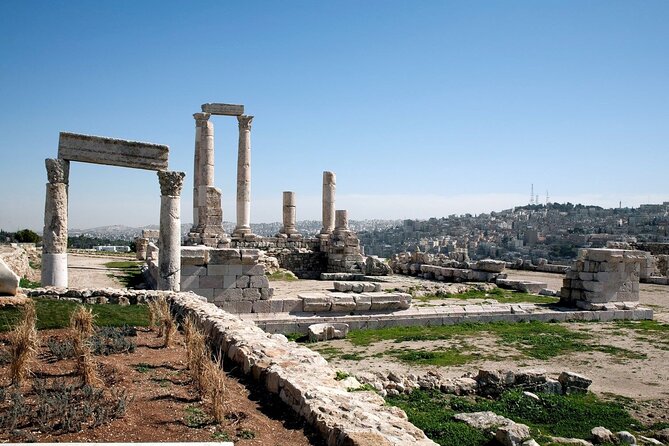
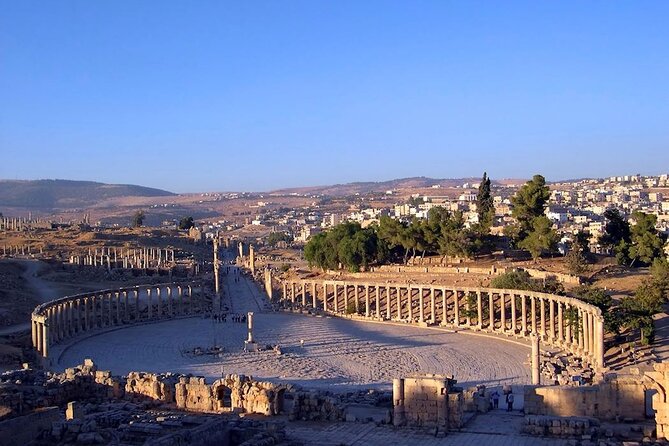
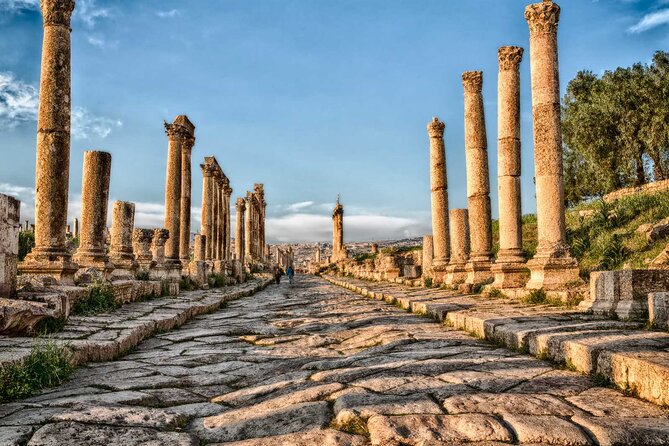
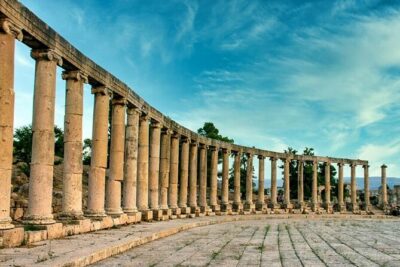
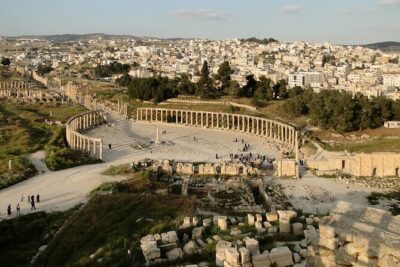
Jerash is the central reason to choose this tour. It is Jordan’s largest Roman site and one of the best-preserved Roman cities in the world. The scale is impressive, but the appeal is not just size. The remains let you follow the shape of an ancient city.
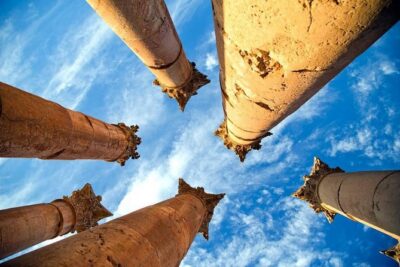
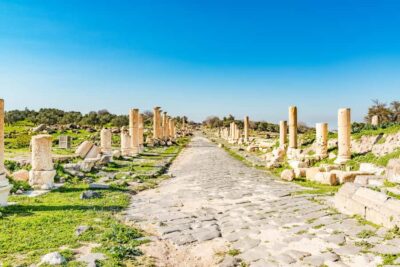
You can expect ceremonial gates, colonnaded avenues, temples, theaters, plazas, and fallen columns. These structures once served an imperial center that was busy with civic, religious, and public activity under Roman rule. Even if you are only mildly interested in archaeology, the layout gives you plenty to see.
The planned visit lasts about two hours. That is the minimum time suggested for the main ruins at a relaxed pace. You can walk along the ancient avenues, pause beside the columns, and sit for a moment to enjoy the views. The stop should not be rushed, but it also will not cover every corner of this large site.
Jerash has one important weakness: signage is scarce. At first, the ruins may seem like a collection of impressive stones without a clear story. I strongly recommend hiring a local guide at the ticket checkpoint if you want the site to make sense.
The tour details quote a guide fee of JD20. A separate booking note describes a guide costing JD30 shared among four people. Since those figures do not match, ask for the current price before starting. Either way, sharing the fee can make the guide a sensible purchase for a small private group.
A guide can help you understand what you are looking at, point out the main route, and put the temples and theaters into context. Without one, you can still enjoy the architecture, but you may miss the reason each space mattered.
Bring a hat and sunscreen during warm months. Much of Jerash is open and exposed, with little shade across the ancient streets. Bottled water is included in the vehicle, but you should still manage your drinking water carefully during the two-hour walk.
Transport, timing, and the private format
The tour uses a modern, air-conditioned vehicle. That matters in Jordan, where time outdoors can become tiring, particularly at the exposed ruins of Jerash. Hotel pickup and drop-off are included within Amman, so you do not need to arrange separate transport to the starting point.
The English-speaking driver can make the day easier, especially for moving between sites and handling the general flow of the visit. WiFi on board is also included, along with bottled water. These are small features, but they improve a long sightseeing day.
This is a private activity, so only your group participates. That gives you more privacy and avoids waiting for strangers at every stop. It does not guarantee unlimited time at each site, since the total tour remains about six to seven hours and includes several major stops.
The schedule allocates one hour to the Citadel, 30 minutes to the Roman Theatre, 30 minutes to King Abdullah Mosque, and two hours to Jerash. The remaining time covers driving and the practical movement between sights. You should treat the time estimates as a useful framework, not a promise that you can add several extra stops.
The downtown walking experience deserves a realistic note. The tour description includes walking through streets and markets to experience local life, but the listed stops focus on the Citadel, Roman Theatre, mosque, and Jerash. If downtown markets are important to you, ask the driver how much time is available before the day begins.
What the $79 price really buys
At $79 per person, the price is easiest to justify when you value private transport and hotel service. You receive an air-conditioned vehicle, an English-speaking driver, bottled water, WiFi, and private pickup and drop-off in Amman. Group discounts are also offered, which may improve the price for a larger party.
The cost does not cover admission tickets or a local guide. That means the advertised price is not the full cost of the day. You should set aside extra money for entrance fees at the Citadel, Roman Theatre, King Abdullah Mosque, and Jerash, plus the guide fee if you choose one.
For two people, the per-person total may feel less attractive than a shared group tour. For four people, the private vehicle and the ability to divide a guide fee can make the arrangement more reasonable. The booking note about sharing a JD30 guide fee among four people is a useful example, though you should confirm the current charge.
I see the tour as a convenience purchase rather than a bargain archaeological package. You are paying to connect Amman and Jerash in one day without arranging the route yourself. If you want the lowest possible cost, admission extras and the private format deserve close attention.
Who should choose this day out?
I would recommend this tour to a first-time visitor with one free day in Amman who wants both major city sights and Jordan’s leading Roman site. It also suits couples, families, and small groups who value a private vehicle and hotel pickup.
It is a good match if you want a broad introduction rather than a slow study of one place. You can see the ancient Citadel, a major Roman theatre, a modern mosque, and the ruins of Jerash in one outing.
You may want another option if you prefer long market visits, extended time at each archaeological site, or detailed interpretation included in the price. The local guide is extra, and two hours at Jerash may feel short to serious archaeology fans.
The physical demands are moderate but real. The Citadel involves a hilltop visit, the theatre has steep seating, and Jerash requires walking across a large exposed site. Most people can participate, but comfortable shoes, sun protection, and a sensible pace will make the day better.
Booking, cancellation, and final advice
Confirmation is provided when you book, and free cancellation is available if you cancel at least 24 hours before the experience start time. Changes or cancellations made inside that 24-hour window are not accepted for a refund, with cut-off times based on Jordan’s local time.
I would book this tour if you want a private, well-organized way to connect Amman’s principal sights with Jerash. Before paying, ask two practical questions: what the current admission costs are, and what the local guide fee will be on your date.
Choose it for the air-conditioned vehicle, hotel service, private format, and strong Jerash focus. Skip it if you want admissions and guiding bundled into one transparent price, or if downtown Amman markets are your main goal. For the best version of this day, reserve enough time for Jerash, share a guide with your group, and protect yourself from the sun.
FAQ
How long does the tour last?
The tour lasts approximately six to seven hours.
Is hotel pickup included?
Yes. Hotel pickup and drop-off are included for hotels in Amman.
Is this a private tour?
Yes. Only your group participates in the activity.
What type of vehicle is provided?
The tour uses a modern, air-conditioned vehicle.
Is an English-speaking driver included?
Yes. An English-speaking driver is included.
Is a local guide included?
No. A local guide is not included in the tour price.
How much time is planned at Jerash?
The planned visit to the Jerash ruins lasts about two hours.
Are admission tickets included?
No. Admission tickets for the listed attractions are not included.
Is King Abdullah Mosque open to non-Muslim visitors?
Yes. It is described as the only mosque in Amman that openly welcomes non-Muslim visitors.
Can I cancel for a full refund?
Yes, if you cancel at least 24 hours before the experience start time. Cancellations made less than 24 hours before the start time are not refunded.
Just added around Amman
- Amman Airport Private Round-Trip Transfer to Amman★ 5.0 · 3 reviews
- Petra Full-Day Private Tour from Amman or Airport★ 5.0 · 3 reviews
- Full Day Amman Old and New Private City Tour★ 5.0 · 3 reviews
- From Amman :Full day Dead Sea and Ma’in Hot spring tour★ 5.0 · 3 reviews
- Jordan’s Gems: Tour from Amman to Karak Castle & Dead Sea★ 5.0 · 3 reviews
- Dead Sea Full Day Tour including Lunch★ 5.0 · 3 reviews
- 2-Night Private Jordan Gem Tour: Petra, Wadi Rum, and Aqaba from Amman★ 5.0 · 3 reviews
- Private Half-Day Ma’in Waterfalls and Hot Springs Tour from Amman★ 5.0 · 3 reviews
Jerash & Ajloun Tours, compared.
Full-Day Tour: Umm Qais, Jerash, and Ajloun from Amman
Read our review →
Private Jerash, Ajloun Castle, and Umm Qais Tour
Read our review →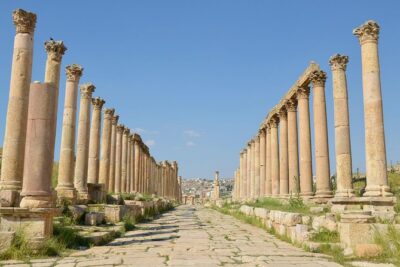
Browse the lists this tour appears in