Reviewed · AMMAN TOURS
Jerusalem and Bethlehem Private Guided Tour
Jerusalem and Bethlehem in one day is a bold plan. This private tour gives you a rare chance to see major Christian, Jewish, and Muslim holy sites from Amman or the Dead Sea without arranging every transfer yourself. I especially like the private vehicle and the chance to travel with an English-speaking driver, plus the strong praise for guides Abu and Ahmer. I also like that the route includes both Jerusalem’s Old City and Bethlehem, rather than stopping at only one.
The trade-off is time. An 11-to-12-hour day includes international border procedures, driving, and a packed sightseeing schedule, so you will get an introduction rather than a slow, reflective visit. Border costs and procedures need careful attention, since basic shuttle transport, visas, departure taxes, and tips are not included.
In This Review
- Key points to know before booking
- What this Amman to Jerusalem tour is really like
- Mount of Olives: Jerusalem’s best opening view
- Temple Mount and the Dome of the Rock
- The Old City: walls, gates, and crowded stone lanes
- The Western Wall and Temple Mount connections
- Via Dolorosa: following the Stations of the Cross
- Church of the Holy Sepulchre: the day’s most important Christian stop
- Tower of David and the old citadel
- Mount Zion and the Last Supper Room
- Bethlehem and the Church of the Nativity
- Is $519.99 per person a fair price?
- Border crossings and the main practical risks
- Who should book this experience?
- Should you book the Jerusalem and Bethlehem day trip?
- FAQ
- How long does the tour last?
- Where does pickup take place?
- Is this a private tour?
- What type of transportation is included?
- Is the border shuttle included?
- What does the VIP border option include?
- Do I need to provide passport information before the tour?
- Can I cancel for a full refund?
Key points to know before booking
- Two countries in one long day: You visit Jerusalem and Bethlehem from Amman or the Dead Sea, with border crossings forming a major part of the schedule.
- A private experience: Only your own group participates, with an air-conditioned vehicle and private transportation.
- Major religious landmarks: The route covers the Mount of Olives, Temple Mount, Western Wall area, Via Dolorosa, Church of the Holy Sepulchre, Mount Zion, and Bethlehem.
- The price reflects convenience: At $519.99 per person, this suits people who value private transport and coordination more than a low-cost day trip.
- VIP border service costs extra: Basic shuttle transport between the Jordanian and Israeli borders is not included. A VIP option is available, but confirm every supplement before paying.
- Entry is not guaranteed: Israeli border police may refuse entry or cause delays, and the operator accepts no responsibility for that possibility.
What this Amman to Jerusalem tour is really like
This is not a leisurely sightseeing day. It is a highly ambitious cross-border excursion designed to give you a first look at two of the world’s most important religious cities.
You begin with pickup in Amman or at the Dead Sea, then cross from Jordan into Israel. The exact amount of time at the border can vary, and that uncertainty matters. The tour promises private transportation, but the basic shuttle between the Jordanian and Israeli borders is an extra cost. You can choose a VIP border option that includes guide, entry, and VIP service, but the price should be explained clearly before departure.
Once inside Israel, an English-speaking driver takes you through the Jerusalem portion of the day. The schedule allows about 30 minutes at most Jerusalem stops, with one hour in Bethlehem. That is enough to see the main places and understand their importance, but not enough to study museums, attend services, wait through long lines, or linger at every shrine.
I would think of this as a highlights tour for a first visit, not a full pilgrimage. You will see the great names and most important viewpoints. You will also spend much of the day moving between them.
A few more trips worth weighing up before you book
- Amman: Petra, Wadi Rum, and Dead Sea 2-Day Tour
★ 4.9 · 1,173 reviews - 2-Day Tour: Petra, Wadi Rum, and Dead Sea from Amman
★ 5.0 · 1,141 reviews - From Amman: Petra & Wadi Rum Private or group Day Tour
★ 4.9 · 750 reviews
Mount of Olives: Jerusalem’s best opening view
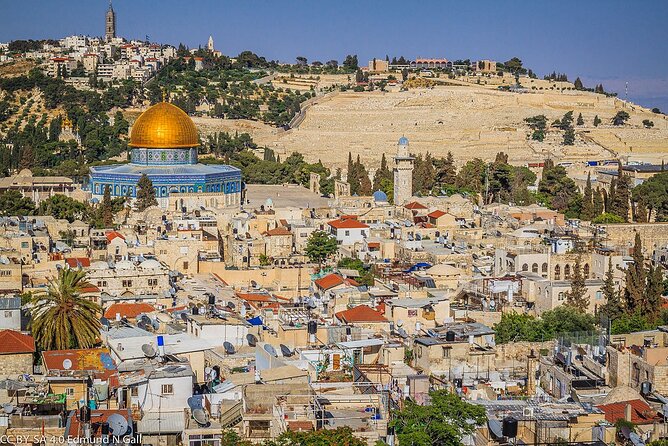
The Mount of Olives is a strong place to begin because it gives you a wide view over Jerusalem’s Old City. From the hill, you can see the dense stone walls, the Temple Mount, and the golden Dome of the Rock. Even if you are not visiting for religious reasons, the view helps you understand Jerusalem’s layout.
The hill has special meaning in Jewish and Christian tradition. It is associated with the future resurrection of the dead, and Christian tradition identifies it as the place where Jesus ascended to heaven after the resurrection.
The route includes the Church of the Ascension, which dates from 1910, and the Church of the Pater Noster. The latter is linked by tradition to Jesus teaching his disciples. The official stop allows about 30 minutes, so expect a quick look and an explanation rather than a long visit inside each church.
The Mount of Olives is also home to one of the oldest continually used cemeteries in the world. That detail gives the hillside a solemn quality, but the main practical reason to visit is the view. Wear comfortable shoes, since this part of Jerusalem is hilly and the broader day involves walking on old stone streets.
Temple Mount and the Dome of the Rock
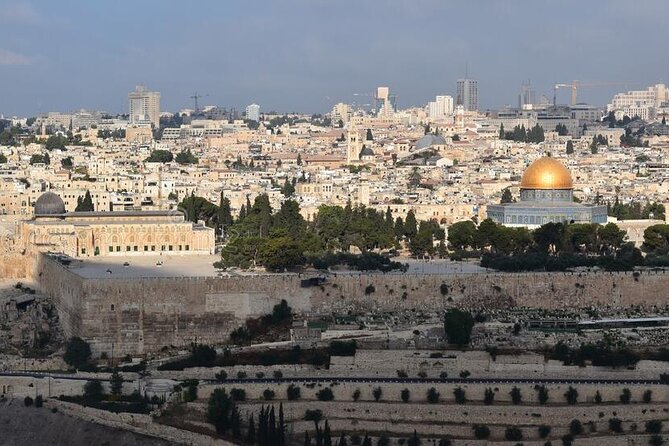
The Temple Mount, known in Islam as Haram Al-Sharif, is one of the most sacred and politically sensitive places in the city. Jewish tradition connects it with the First Temple and with Abraham’s offering of his son. Muslim tradition connects the site with the Prophet Muhammad’s ascent to heaven.
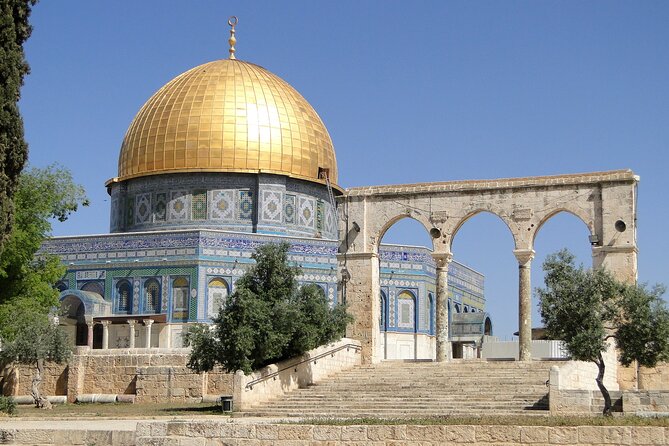
The broad plaza is centered on the Dome of the Rock, Jerusalem’s most recognizable building. Its golden dome catches the eye from many parts of the city, but seeing it from the Temple Mount places the monument in its full religious setting.
The stop is scheduled for about 30 minutes, and admission is not included. Access rules can be strict and may change. You should not assume that a short stop guarantees entry into every structure or shrine. The tour’s wording promises a visit to the site, but the exact access you receive can depend on local controls.
This is a place where your driver’s local guidance matters. The religious meaning is layered, and the political sensitivities are real. Listen closely, dress respectfully, and allow the site to speak for itself rather than treating it as just another photo stop.
The Old City: walls, gates, and crowded stone lanes
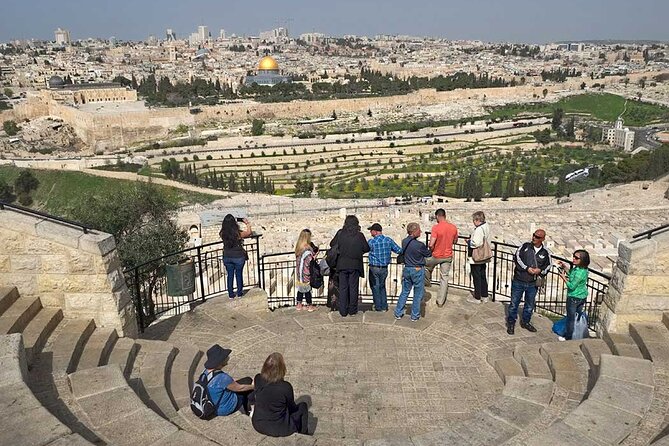
Jerusalem’s Old City is enclosed by Ottoman-era walls and entered through historic gates. The tour uses Zion Gate to enter, placing you near the Jewish Quarter and Mount Zion.
You will hear about Damascus Gate, Lion’s Gate, Zion Gate, and Jaffa Gate. Each gate points toward a different part of the city and its long religious and civic story. Jaffa Gate is the main passage toward the Christian Quarter, while Lion’s Gate leads toward the Mount of Olives. Dung Gate is near the Western Wall.
The Old City stop itself is listed at about 30 minutes, but the route through the Old City also includes the Western Wall, Via Dolorosa, and Church of the Holy Sepulchre. In practice, you should expect the Old City portion to feel like a connected walking circuit rather than three isolated visits.
The old streets are uneven, narrow, and easy to lose track of. That is one reason a private guide or driver is useful on a first visit. You get a basic orientation without having to work out the gates and quarters on your own.
Still, do not expect a relaxed walk along the ramparts or a museum visit. The Tower of David Museum is not included, and the allotted time is too short for anything more than a glimpse of the Citadel exterior unless your schedule changes.
A completely different kind of day out around Amman:
- From Amman: Petra and Wadi rum Full day Tour
★ 5.0 · 538 reviews - 2-Day Petra, Wadi Rum and Dead Sea Tour from Amman
★ 5.0 · 467 reviews - 3-Day Private Tour from Amman: Petra, Wadi Rum, Dana, Aqaba, and Dead Sea
★ 5.0 · 425 reviews - Petra Full-Day Private Tour from Amman
★ 4.9 · 392 reviews
The Western Wall and Temple Mount connections
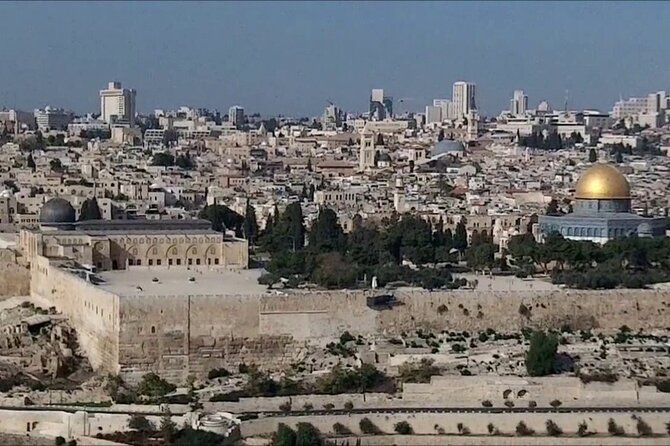
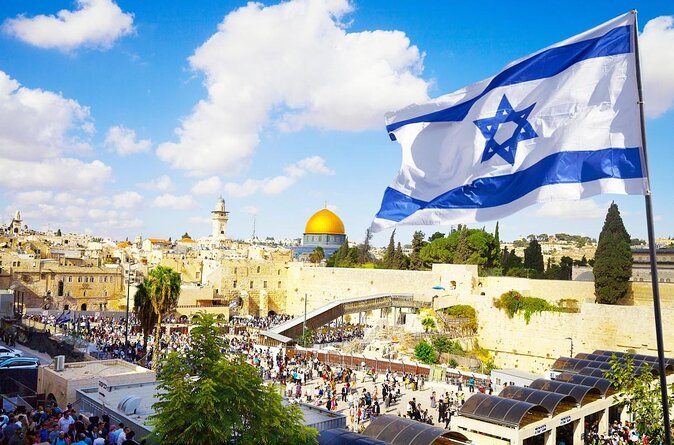
The Western Wall is one of the most important Jewish prayer sites in the world. It is part of the retaining wall of the Temple Mount complex and sits below the plaza where the ancient Jewish temples once stood.
The tour brings you into the religious center of Jerusalem, where Jewish, Christian, and Muslim traditions overlap within a very small area. That proximity is one of the most powerful parts of the day. You can move from the Western Wall area toward the Temple Mount and then into the Christian Quarter in a short walk.
Your time here will be limited. A 30-minute stop may allow you to observe the prayer area and hear the basic explanation, but not to explore every section or absorb the atmosphere at length. Since the tour crosses several religious sites, modest clothing and respectful behavior are sensible choices.
Via Dolorosa: following the Stations of the Cross
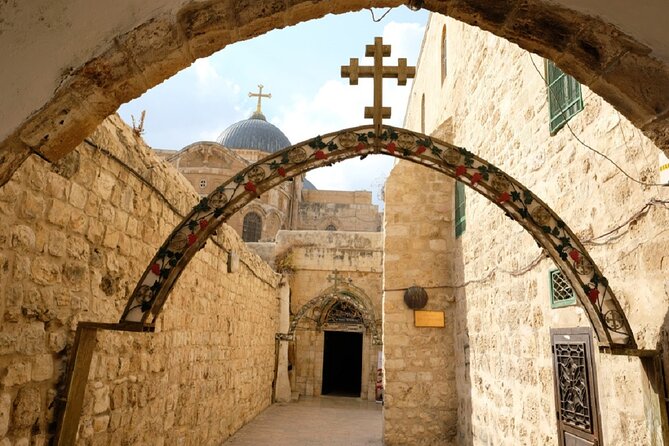
The Via Dolorosa is the traditional route associated with Jesus carrying the cross after his condemnation. Fourteen Stations of the Cross mark the journey, with some based on Gospel accounts and others on long-held Christian tradition.
The route begins near the intersection of Via Dolorosa and Al-Wad Street. It then passes through the Old City before reaching the Church of the Holy Sepulchre, where the final five stations are located.
The walk is not a grand ceremonial avenue. It is a working Old City street, lined with shops and framed by worn stone buildings. That contrast is part of the experience. A sacred route runs through an ordinary neighborhood, and you see religious devotion alongside daily commerce.
The tour allows about 30 minutes here. That is enough to follow part of the route and understand its pattern, but not enough for a slow pilgrimage. If the religious meaning is central to your visit, you may want to return another day and walk the route at your own pace.
Church of the Holy Sepulchre: the day’s most important Christian stop
For Christian pilgrims, the Church of the Holy Sepulchre is likely the emotional center of the Jerusalem visit. It is traditionally located at the site of Jesus’ crucifixion, known as Calvary or Golgotha, and it contains the last five Stations of the Cross.
The church’s origins reach back to the fourth century, when Saint Helena, the mother of Constantine the Great, identified the site for the Byzantine Christian world. The original church was destroyed in 1009, and the present building largely dates from the 11th century.
Inside, you will find a complex and richly decorated religious space shared by several Christian communities. It can be crowded, and the atmosphere may shift quickly from quiet prayer to a line of people waiting for access to a particular shrine.
The planned 30-minute stop is short, especially if queues form. Admission is not separately included in the tour information, so ask what the guide means by access and whether any local fees apply. This is one of the places where flexibility would improve the day, but the tight schedule makes that difficult.
Tower of David and the old citadel
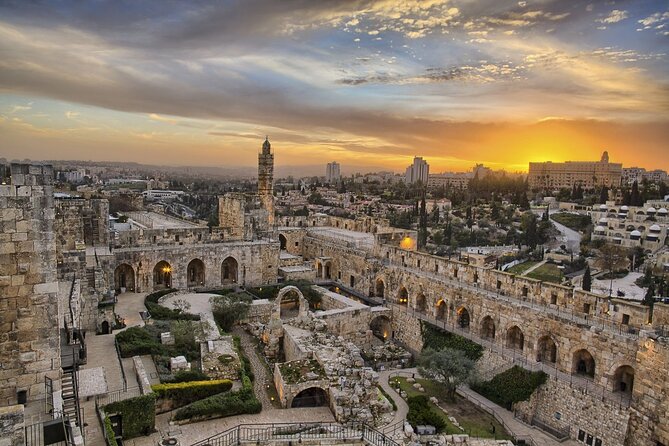
The Tower of David is a useful reminder that Jerusalem’s names can be misleading. Despite its popular title, the citadel has no direct connection to King David. King Herod built the original defensive complex around 24 BCE to protect his palace.
The first towers were named for Herod’s brother Phasael, his wife Mariamne, and his friend Hippicus. Romans, Crusaders, Mamelukes, and Ottomans later altered or rebuilt the site. The structure you see today was built in the 14th century on the foundations of Phasael Tower.
The Tower of David Museum is inside the citadel and explains Jerusalem’s long story through archaeological displays. Admission is not included, and the 30-minute stop leaves little time for a proper museum visit.
I would treat this as a historical orientation point. It helps you see why the Old City has such strong defenses and why so many rulers wanted control of Jerusalem. If you want the museum, you need a separate visit.
Mount Zion and the Last Supper Room
Mount Zion lies just south of the Old City’s Zion Gate and brings together Jewish, Muslim, and Christian traditions.
Christian tradition connects the hill with the Last Supper and with the final years of the Virgin Mary. Jewish tradition identifies it with King David’s Tomb. Nearby sites include the Church of the Dormition and the Church of St. Peter of Gallicantu, associated with Peter’s denial of Jesus.
The Last Supper Room has served as both a church and a mosque. That layered use gives the site a particularly clear sense of Jerusalem’s overlapping faiths. You will not need to choose one tradition to appreciate the place. The value is in seeing how several communities have understood the same hill.
The stop allows about 30 minutes, and admission is not included. The schedule is enough for an introduction, but not a detailed tour of all the shrines on Mount Zion.
Bethlehem and the Church of the Nativity
After Jerusalem, the tour continues to Bethlehem in the West Bank, about 10 kilometers south of Jerusalem. The city’s name means House of Bread in Hebrew, and its importance reaches beyond the Christmas story.
The Old Testament identifies Bethlehem as the city of David, where he was crowned the first king of Israel. Rachel’s Tomb is also at the northern entrance and is an important Jewish holy site.
The main Christian attraction is the Church of the Nativity. Beneath the church, an underground grotto marks the traditional place of Jesus’ birth. This is the reason many people choose this tour instead of a Jerusalem-only day. You get to connect the birthplace tradition with the crucifixion and resurrection sites in Jerusalem.
The Bethlehem visit is planned for one hour, giving it more time than most Jerusalem stops. Even so, a line at the grotto could reduce your actual time inside. You should see Bethlehem as a meaningful final chapter, not as a full city tour.
Is $519.99 per person a fair price?
At $519.99 per person, this is expensive for a day trip. The price makes more sense if you are traveling with a small private group and place a high value on a private vehicle, an English-speaking driver, and help coordinating a complicated international route.
It is less attractive if your main goal is simply to reach Jerusalem as cheaply as possible. The cost does not cover the driver’s tip, visa and departure taxes, or the basic shuttle bus between the Jordanian and Israeli borders. The optional VIP border service adds another layer of expense.
One important warning: ask for a written breakdown of every border charge. An unhappy customer described being offered $175 and $75 supplements without understanding what they covered. That does not prove the service is improper, but it is a good reason to ask precise questions before you commit. Find out what is included, who receives each payment, and what happens if the border crossing takes longer than expected.
The price is easier to justify for a group than for one person. Group discounts are offered, and since the activity is private, splitting the cost can improve the value.
Border crossings and the main practical risks
The border is the least predictable part of this experience. You must provide a passport copy at least 48 hours before departure so the operator can arrange a permit for the car and driver to meet you inside the border.
Israeli border police can refuse entry or delay you. The operator does not accept responsibility for that outcome. This is not a minor footnote. If your wider trip depends on arriving back in Amman at a certain hour, leave plenty of room in your plans.
The return crossing can also be confusing. One person had trouble finding the ride back to Amman after re-entering Jordan, while other guests had a smooth crossing with Abu and Ahmer. I would ask in advance:
- Where exactly will the Jordan-side driver meet you?
- What name or phone number should you use at the border?
- Is the shuttle included or extra?
- What does VIP service cover?
- Are visa and departure taxes payable separately?
The tour is private, but border procedures are not under the operator’s control. That distinction is important.
Who should book this experience?
I would recommend this tour to someone with only one available day, a strong interest in religious history, and a preference for private transport. It also suits a couple, family, or small group that wants a direct route and does not want to coordinate multiple vehicles alone.
The tour is a good fit if you are comfortable with a brisk pace. You will see the central sites, but you will not have much spare time for shopping, museums, extended prayer, or quiet wandering.
I would think twice if you dislike border uncertainty, need guaranteed arrival times, or want an in-depth visit to Jerusalem. The price is also hard to defend for a solo visitor unless the convenience is worth more to you than saving money.
The strongest praise centers on the staff who make the border and sightseeing process easier. Abu and Ahmer receive especially warm approval for making the crossing smooth and the day enjoyable. That kind of assistance can be worth a great deal on a complicated route, but confirm who will meet you on each side before you go.
Should you book the Jerusalem and Bethlehem day trip?
Book it if you want the major sacred sites in one demanding day and value private coordination more than a bargain price. The Mount of Olives view, Church of the Holy Sepulchre, Via Dolorosa, and Church of the Nativity give you a powerful first look at Jerusalem and Bethlehem.
Skip it if you need a slow pace or cannot tolerate uncertainty at the border. Before paying, confirm the shuttle fee, VIP supplements, visa costs, departure taxes, meeting points, and the exact plan for returning to Amman. Free cancellation is available until 24 hours before the start time, so use that window to clarify anything that remains vague.
FAQ
How long does the tour last?
The tour lasts approximately 11 to 12 hours, including transportation and the border crossings.
Where does pickup take place?
Pickup is offered from Amman or the Dead Sea.
Is this a private tour?
Yes. Only your own group participates in the activity.
What type of transportation is included?
An air-conditioned vehicle and private transportation are included.
Is the border shuttle included?
The basic shuttle bus between the Jordanian and Israeli borders is not included. A VIP service option is available for an additional cost.
What does the VIP border option include?
The VIP option includes guide, entry, and VIP service between the borders.
Do I need to provide passport information before the tour?
Yes. A passport copy must be provided at least 48 hours before the tour so a permit can be arranged for the car and driver to meet you inside the border.
Can I cancel for a full refund?
Yes. You can cancel up to 24 hours before the experience start time for a full refund. Changes or cancellations made less than 24 hours in advance are not accepted for a refund.
Just added around Amman
- Amman Airport Private Round-Trip Transfer to Amman★ 5.0 · 3 reviews
- Petra Full-Day Private Tour from Amman or Airport★ 5.0 · 3 reviews
- Full Day Amman Old and New Private City Tour★ 5.0 · 3 reviews
- From Amman :Full day Dead Sea and Ma’in Hot spring tour★ 5.0 · 3 reviews
- Jordan’s Gems: Tour from Amman to Karak Castle & Dead Sea★ 5.0 · 3 reviews
- Dead Sea Full Day Tour including Lunch★ 5.0 · 3 reviews
- 2-Night Private Jordan Gem Tour: Petra, Wadi Rum, and Aqaba from Amman★ 5.0 · 3 reviews
- Private Half-Day Ma’in Waterfalls and Hot Springs Tour from Amman★ 5.0 · 3 reviews
Amman Tours, compared.
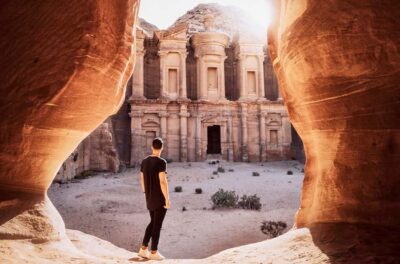
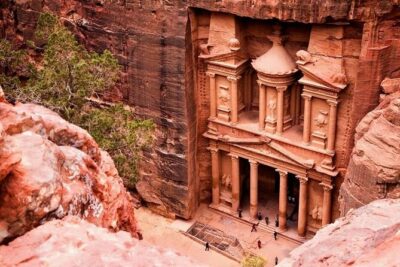
2-Day Tour: Petra, Wadi Rum, and Dead Sea from Amman
Read our review →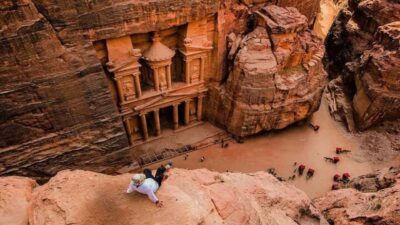
2-Day Petra, Wadi Rum and Dead Sea Tour from Amman
Read our review →
3-Day Private Tour from Amman: Petra, Wadi Rum, Dana, Aqaba, and Dead Sea
Read our review →