Reviewed · AMMAN TOURS
Panorama Jordan Tour 11 Day 10 Nights Tour
Jordan rewards a slow, wide-ranging route. This private 11-day journey links Petra and Wadi Rum with quieter places such as Dana, Salt, and Shaumari Reserve. I like the personal airport welcome and the private vehicle, and I also like having two full days at Petra instead of rushing through it. The main drawback is pace: long drives, early starts, and several full sightseeing days require decent stamina.
The tour costs $1,641.03 per person and includes hotels, transfers, entrance fees, breakfasts, selected dinners, guides, and Jordan’s free visa when passport details are provided ahead of time. I also appreciate that the strongest praise for Jordan Horizons Tours focuses on careful planning, quick responses from Aida, and the personal help offered by Hisham and Suleiman.
This is not a tiny, slow-moving village tour. It covers much of Jordan from north to south and back again. You will spend time in a private car, but that trade-off brings comfort, flexibility, and a driver who helps keep the complicated parts moving.
In This Review
- Key points to know before booking
- Arrival in Amman with the paperwork handled
- Madaba, Mount Nebo, and the Kings Highway
- Dana and Little Petra, two very different stops
- Petra over two days, with time for the big climbs
- Wadi Rum by Bedouin 4×4
- The Dead Sea, a pause after the desert
- Salt and Jerash, Jordan’s northern highlights
- Eastern desert castles and Shaumari wildlife
- Amman’s blue dome, Citadel, and Roman Theatre
- What the $1,641.03 price really covers
- Who will enjoy this Jordan route most
- Should you book Panorama Jordan?
- FAQ
- How long is the Panorama Jordan Tour?
- Is this a private tour?
- Does the tour include Jordan’s visa fee?
- How many nights are included in each destination?
- Is Petra guided?
- What is included in the Wadi Rum visit?
- Are tips and camel or horse rides included?
Key points to know before booking
- Two days at Petra: One day includes a three-hour guided walk, while the next gives you time for extra trails and monuments.
- A real range of Jordan: The route includes Byzantine mosaics, Crusader castles, Roman ruins, desert forts, wildlife, the Dead Sea, and Bedouin-guided Wadi Rum.
- Private transport: Your group travels by modern vehicle with an English-speaking driver rather than joining a large coach.
- Dana adds a quieter stop: The easy two-kilometer village walk passes Ottoman buildings, terraces, gardens, and craft workshops.
- Wadi Rum is an active day: Expect four to five hours in a 4×4, with sand dunes, canyons, rock bridges, and a box lunch.
- Most major costs are arranged: Hotels, listed admission fees, airport transfers, guides, mineral water, breakfasts, and selected meals are included, but tips and personal spending are extra.
Arrival in Amman with the paperwork handled
Your Jordan trip begins at Queen Alia Airport. A representative meets you before Visa Control with a sign bearing your name and handles the paperwork for the free Jordanian visa. That small service matters after a flight, since you do not have to work out the arrival process alone.
The transfer to Amman takes about 30 minutes. You then check into your hotel, with no sightseeing scheduled for the first day. That is sensible. You can settle in, rest, and save your energy for the road ahead.
The tour includes four nights in Amman, although those nights are spread across the beginning and end of the trip. Your airport arrival and departure transfers are also included, along with an English-speaking driver and mineral water in the vehicle.
A few more trips worth weighing up before you book
- Amman: Petra, Wadi Rum, and Dead Sea 2-Day Tour
★ 4.9 · 1,173 reviews - 2-Day Tour: Petra, Wadi Rum, and Dead Sea from Amman
★ 5.0 · 1,141 reviews - From Amman: Petra & Wadi Rum Private or group Day Tour
★ 4.9 · 750 reviews
Madaba, Mount Nebo, and the Kings Highway
Day two takes you south toward Petra along the Kings Highway, an old route with far more character than a simple highway transfer. The first stop is Madaba, home to the sixth-century mosaic map of Jerusalem and the Holy Land.
The map is made from about two million pieces of colored local stone. Only around a quarter of the original panel remains, but the surviving section still shows hills, valleys, towns, and the Nile Delta. It lies in the Greek Orthodox Church of St. George, built in 1896 over an earlier Byzantine church.
This is a short stop, but do not treat it as filler. The mosaic gives you a useful introduction to Jordan’s Christian and Byzantine past before the trip shifts toward Nabatean and Roman sites.
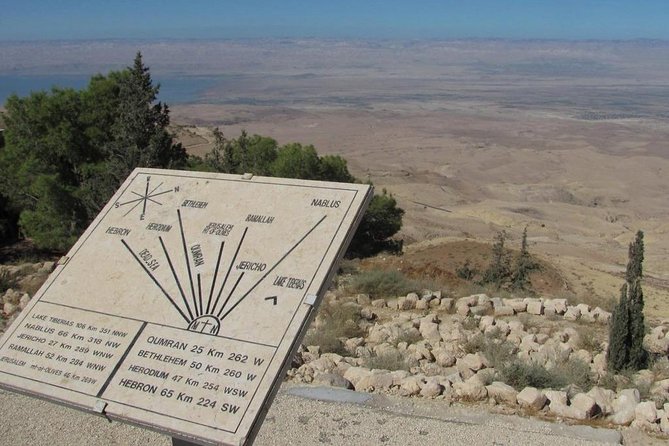
At Mount Nebo, tradition places Moses looking toward the Promised Land. On a clear day, the view reaches over the Dead Sea and toward Jerusalem. Visibility controls how much you see, so keep expectations flexible, but the site remains meaningful for its religious setting and broad outlook.
The Wadi Mujib viewpoint follows. The valley is often called Jordan’s Grand Canyon, and the stop gives you a chance to see its scale without taking a demanding hike.
Karak Castle adds a medieval turn. King Baldwin I of Jerusalem built the Crusader fortress in 1132 or 1134. You receive about 45 minutes there, enough for a quick look at the heavy stone defenses and the castle’s position above the surrounding valleys.
The day ends in Dana. The route is excellent for seeing how quickly Jordan changes, from church mosaics and Christian pilgrimage sites to dry valleys and Crusader fortifications. It is also a long sightseeing day, so comfortable shoes and water are useful.
Dana and Little Petra, two very different stops
Dana gives you a welcome change of speed. After breakfast at camp, you take the self-guided Dana Village Tour, an easy two-kilometer walk available from 8 a.m. to 3 p.m. Starting at the Dana Guesthouse, the path passes above the village, through terraced gardens, and by local craft workshops.
The walk takes about an hour. You can meet local residents, see original Ottoman architecture, and learn about the village without needing a strenuous trek. This is one of the better-balanced parts of the route because it offers contact with a lived-in community rather than another monumental site.
Do not expect a major guided hike here. The village walk is self-guided and short. If you want a serious nature hike in Dana Nature Reserve, this program does not promise one. The tour gives you an easy introduction instead.
Shobak Castle comes next. It is more ruined than Karak, but its mountaintop position overlooking the valleys is the reason to stop. Thirty minutes is brief, so think of Shobak as a scenic historical pause rather than a full castle visit.
Then comes Al-Beidha, better known as Little Petra. The site contains Nabatean dining rooms, including tricliniums and a biclinium. One biclinium still has surviving Nabatean fresco work on its ceiling, an unusual detail that makes the visit worthwhile.
The three-hour stop allows more time than Shobak, and Little Petra works well as a preview of Petra itself. You see carved stone spaces and Nabatean design on a smaller scale, before tackling the much larger ancient capital the next day.
Petra over two days, with time for the big climbs
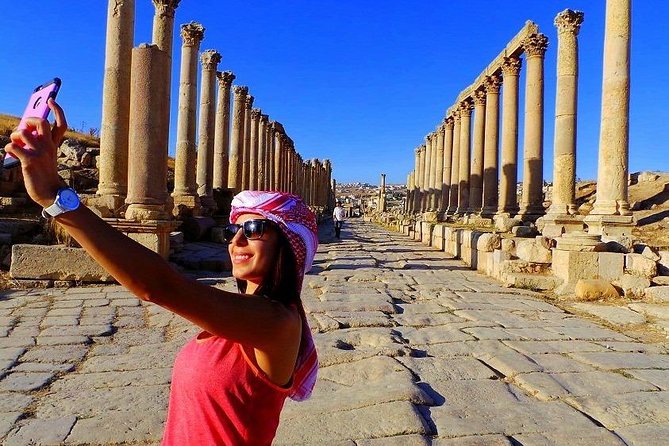
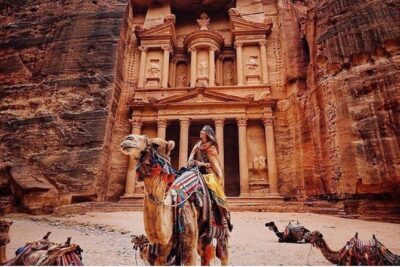
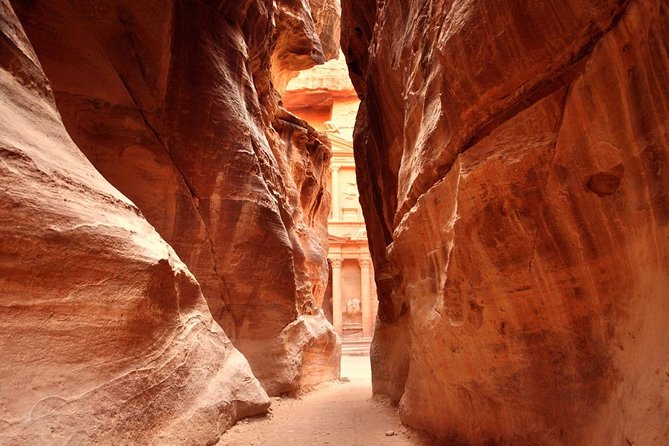
Petra is the heart of the journey, and the schedule gets this part right. Your first day includes an English-speaking guide for three hours, followed by free time. You walk about 1.2 kilometers through the Siq, a narrow chasm lined with shrines, tombs, and carvings.
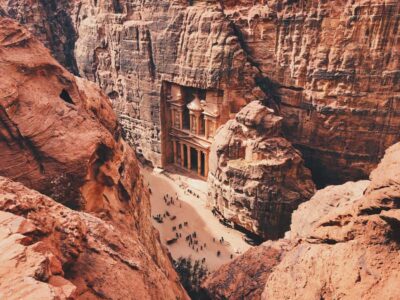
The Siq opens onto the Treasury, Petra’s most famous view. From there, the guided route continues through the Street of Facades, the Roman Theatre, the Colonnaded Street, and Qasr Bint. The guided portion ends there, but the full Petra visit lasts about seven hours.
A guide helps you understand what you are seeing instead of simply walking from one photograph to the next. The three-hour limit also leaves room for independent exploring, which is important because Petra is too large to appreciate in a quick, fixed route.
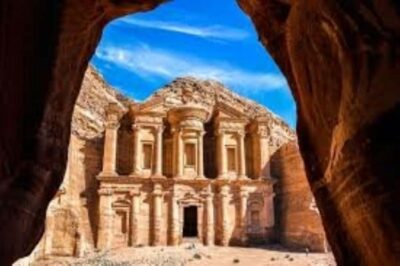
You can use the free time for the Byzantine Church, the Temple of the Winged Lion’s, or one of Petra’s climbs. The Monastery requires about 800 steps. The High Place of Sacrifice is a shorter climb, but neither is a casual stroll in hot weather.
The second Petra day lasts about eight hours. You can explore independently or choose optional guided trails. This extra day is a major reason I see value in the tour. Petra is not a single monument. It is a large archaeological area where you need time to pause, climb, backtrack, and sit with the place.
The practical warning is simple: plan for heat, uneven ground, and plenty of walking. The tour asks for moderate physical fitness, and that description is fair. You do not need to be an athlete, but Petra rewards people who are comfortable walking for hours.
You should also clarify the optional trails and any additional charges before setting out. Horse carriages and camel rides are not included, and tips for guides and drivers are also separate.
A completely different kind of day out around Amman:
- From Amman: Petra and Wadi rum Full day Tour
★ 5.0 · 538 reviews - 2-Day Petra, Wadi Rum and Dead Sea Tour from Amman
★ 5.0 · 467 reviews - 3-Day Private Tour from Amman: Petra, Wadi Rum, Dana, Aqaba, and Dead Sea
★ 5.0 · 425 reviews - Petra Full-Day Private Tour from Amman
★ 4.9 · 392 reviews
Wadi Rum by Bedouin 4×4
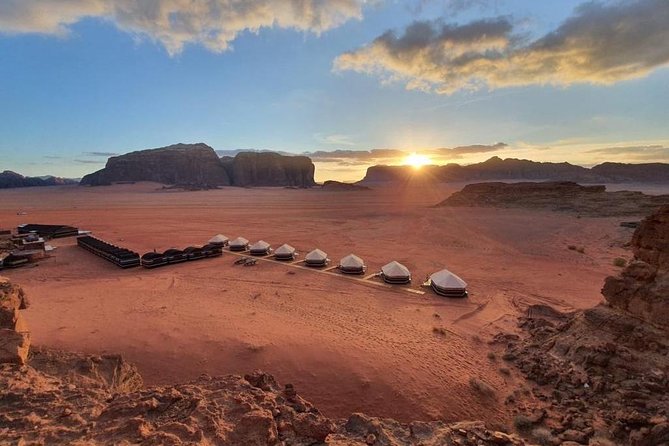
After Petra, your driver takes you about 1.5 hours to Wadi Rum. At Wadi Rum Village, an English-speaking Bedouin guide meets you. The welcome includes tea and coffee, with an opportunity to meet members of the guide’s family.
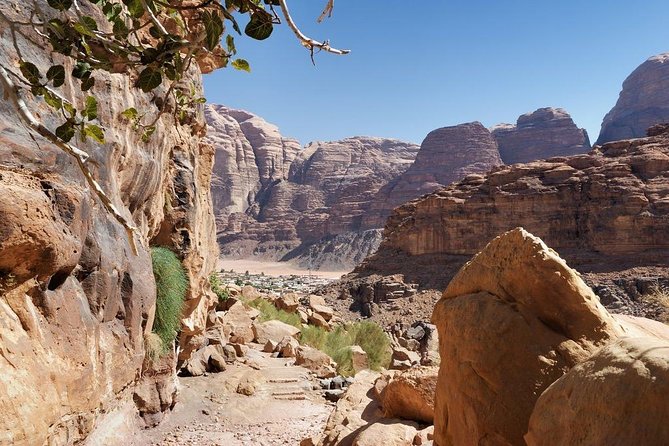
The four to five-hour Jeep tour is the day’s main event. You ride in a 4×4 through the desert, following places linked with Lawrence of Arabia and stopping at sites such as the Nabatean Temple, Lawrence Spring, Khazali Canyon, Little Bridge, Um Frouth Rock Bridge, Lawrence House, and the Burdah rock formations.
Sand dunes and rock bridges give the day physical variety. You are not just being driven from one viewpoint to another. The route includes chances to climb sand and stone, so sturdy shoes and sun protection make sense.
A box lunch is provided during the Jeep tour. Dinner and breakfast are included at the Wadi Rum camp, making this one of the clearest all-in-one portions of the trip.
The overnight camp also gives you a different feel from the city hotels. Still, keep the word camp in mind. The exact accommodation style is not specified, so ask what type of tent or room is provided if that matters to you.
The Dead Sea, a pause after the desert
Day seven is deliberately light. After breakfast at camp, your driver takes you along the Dead Sea Highway to your hotel area at the Dead Sea.
One night is included at the Dead Sea with breakfast. No formal sightseeing stop is listed for this day, which is useful after Petra and Wadi Rum. You have time to rest and enjoy the hotel area rather than rushing into another fortress or ruin.
The program does not specify a spa treatment, beach access, or a particular Dead Sea activity. Those details can vary by hotel, so ask what is included if floating or resort facilities are central to your plans.
Salt and Jerash, Jordan’s northern highlights
Day eight heads north to Salt, a city of late Ottoman houses and picturesque streets. Hammam Street is the best place to get a feel for daily life, with small shops selling food, produce, clothing, perfumes, sweets, bedding, crafts, and household goods.
Al Ein Plaza is described as the heart of the city. You may see older men playing Manqala and hear the call to prayer. That kind of ordinary street detail is why Salt earns its place on the route. It is not simply another archaeological stop.
You have about three hours in Salt. That is enough for a walk and some browsing, but not enough to treat the city as a long, unstructured visit. Keep the pace easy and enjoy the shops rather than trying to inspect every street.
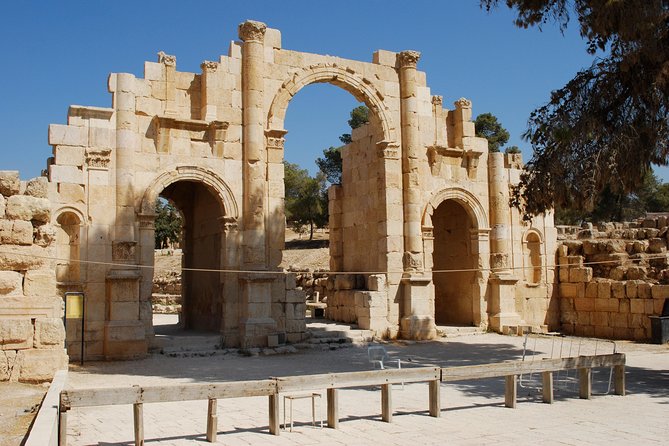
Jerash follows with a 1.5-hour guided tour. The Roman city includes Hadrian’s Arch, the Hippodrome, the Forum, the Temple of Artemis, the Colonnaded Street, and the Nymphaeum.
The scale is impressive. The drums of the Temple of Artemis columns weigh between 20 and 40 tons, and the Hippodrome once held 15,000 spectators. The guide’s short tour helps connect those remains to the city’s role among the Decapolis towns.
You then return to Amman for the night. The combination of Salt and Jerash works well, but it is another full day with time on the road. The private vehicle makes the schedule much easier than public transport would.
Eastern desert castles and Shaumari wildlife
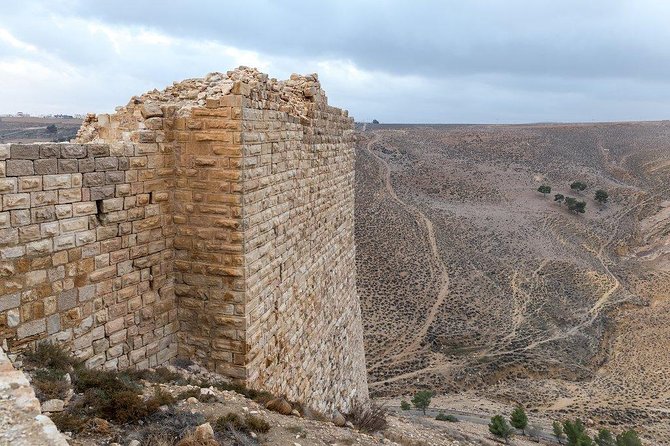
Day nine heads east to Jordan’s desert castles. The route includes Qusayr Amra, Qasr Kharana, and Qasr al-Azraq.
Qusayr Amra is the artistic highlight. Its preserved eighth-century frescoes show scenes of music, bathing, wine, and nude figures, a frank contrast to the military look of many desert fortifications. Qasr Kharana is a two-story structure where Mesopotamian, Arabic, and Greek influences appear in the design.
Qasr al-Azraq is built from black basalt. It was first associated with the Umayyad period, but its later connection with T. E. Lawrence gives it another layer of interest.
The three-hour castle visit is a good fit for people who enjoy unusual sites. It is less rewarding if you prefer only the most famous attractions, since the desert route involves driving for places that are smaller and more austere than Petra or Jerash.
In the afternoon, Shaumari Nature Reserve offers a change from stone. The reserve was established to breed and reintroduce animals including Arabian oryx, Persian onagers, Dorcas gazelles, and houbara bustards. A short safari lasts about one to 1.5 hours.
Wildlife sightings are never guaranteed, but the reserve adds an important conservation angle to the trip. It also breaks up a day that could otherwise feel like a sequence of remote forts.
Amman’s blue dome, Citadel, and Roman Theatre
Your final full day covers Amman. The visit begins at King Abdullah Mosque, completed in 1989 as a memorial by the late King Hussein to his grandfather. Its blue dome is easy to spot, and it can hold up to 7,000 worshippers.
This is the only mosque in Amman described as openly welcoming non-Muslim visitors. Dress respectfully and follow the instructions at the entrance.
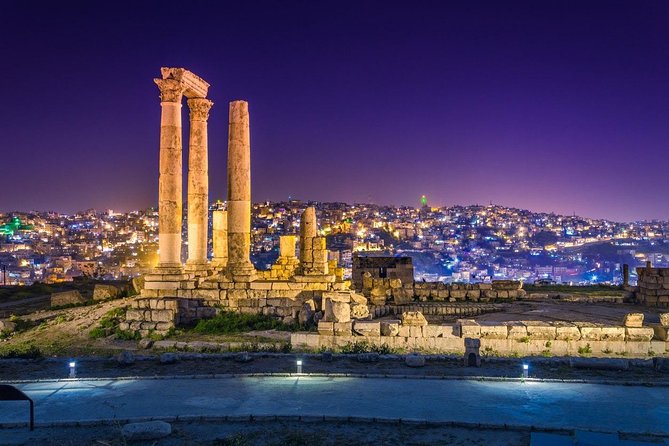
The Amman Citadel sits 132 meters above the city center. The ruins include the Temple of Hercules and an Umayyad palace. The site gives you a useful view over the capital while bringing together several periods of Jordanian history in one place.
The Roman Amphitheatre is another major stop. It is considered one of the largest in the Middle East. The full city tour takes about six hours, so you should not plan a separate major activity afterward.
Your departure comes the following morning. The driver transfers you to Queen Alia Airport, completing a route that has crossed Jordan from Amman to Petra, Wadi Rum, the Dead Sea, and the eastern and northern parts of the country.
What the $1,641.03 price really covers
The price is strong for a private trip of this length, provided you value convenience. It includes 10 nights of accommodation: four nights in Amman, one in Dana, three in Petra, one in Wadi Rum, and one at the Dead Sea.
You also receive 10 breakfasts, two dinners, lunch provisions including the Wadi Rum box lunch, listed entrance fees, airport meet-and-assist service, all ground transfers, mineral water, and the specified guides. Petra includes three hours with an English-speaking guide, Jerash includes 1.5 hours, and Shaumari includes a short safari.
The private format is important. Only your group participates, so you avoid a large coach and have a driver dedicated to your route. That does not mean every stop is fully guided. Much of Dana, the second Petra day, Amman, and the desert castles relies on your driver or independent exploration.
The price does not include tips, personal expenses, horse carriages, or camel rides. The meal details also deserve a close look, since the package does not provide lunch every day. Ask about hotel names, room standards, and the exact camp setup before paying if those points affect your decision.
Who will enjoy this Jordan route most
I would recommend it to someone visiting Jordan for the first time who wants the major sights but also wants Dana, Salt, Shaumari, and the eastern desert. It suits couples, families, and small private groups that value a set plan and a dedicated vehicle.
It is also a good choice if you dislike spending time arranging separate hotels, drivers, entrance tickets, and guides. The planning support praised in connection with Aida, Hisham, and the operating team is especially useful for a trip with this many moving parts.
I would hesitate if you want a slow holiday with late mornings. The schedule includes long drives, seven-hour Petra days, a four to five-hour desert ride, and several early departures. It is also not the best fit if you want a serious Dana trek, since the listed Dana activity is an easy self-guided village walk.
The tour asks for moderate fitness. Petra is the main test, but uneven ground, heat, stairs, and getting in and out of the Jeep also matter.
Should you book Panorama Jordan?
Book it if you want a private, well-organized first look at Jordan and are happy to trade some leisure time for broad coverage. The two days at Petra, Bedouin-led Wadi Rum tour, airport assistance, and private transport give the $1,641.03 price real value.
Before booking, confirm the hotel and camp names, the exact lunch arrangements, the optional Petra trails, and what kind of vehicle will be used. If you prefer a slower trip, consider removing one of the farther day trips. If you want to see Jordan’s main sights in one connected journey, this route gives you a strong mix of famous monuments, local towns, nature reserves, and desert culture.
FAQ
How long is the Panorama Jordan Tour?
The tour lasts approximately 11 days and includes 10 nights of accommodation.
Is this a private tour?
Yes. Only your group participates, and transportation is provided by modern private vehicle with an English-speaking driver.
Does the tour include Jordan’s visa fee?
Yes. The Jordanian visa fee is included when the required passport details are provided in advance. A representative meets you before Visa Control at Queen Alia Airport.
How many nights are included in each destination?
The package includes four nights in Amman, one night in Dana, three nights in Petra, one night in Wadi Rum, and one night at the Dead Sea.
Is Petra guided?
The first Petra day includes a three-hour guided tour with an English-speaking guide. The second day can be spent independently or used for optional guided trails.
What is included in the Wadi Rum visit?
You receive a four to five-hour Jeep tour with an English-speaking Bedouin driver, visits to several desert sites, and a box lunch. Dinner, breakfast, and the Wadi Rum overnight stay are also included.
Are tips and camel or horse rides included?
No. Tips, personal expenses, horse carriages, and camel rides are not included in the tour price.
Just added around Amman
- Amman Airport Private Round-Trip Transfer to Amman★ 5.0 · 3 reviews
- Petra Full-Day Private Tour from Amman or Airport★ 5.0 · 3 reviews
- Full Day Amman Old and New Private City Tour★ 5.0 · 3 reviews
- From Amman :Full day Dead Sea and Ma’in Hot spring tour★ 5.0 · 3 reviews
- Dead Sea Full Day Tour including Lunch★ 5.0 · 3 reviews
- Jordan’s Gems: Tour from Amman to Karak Castle & Dead Sea★ 5.0 · 3 reviews
- 2-Night Private Jordan Gem Tour: Petra, Wadi Rum, and Aqaba from Amman★ 5.0 · 3 reviews
- Full-Days Tours Petra from Amman★ 5.0 · 3 reviews
Amman Tours, compared.
2-Day Tour: Petra, Wadi Rum, and Dead Sea from Amman
Read our review →
2-Day Petra, Wadi Rum and Dead Sea Tour from Amman
Read our review →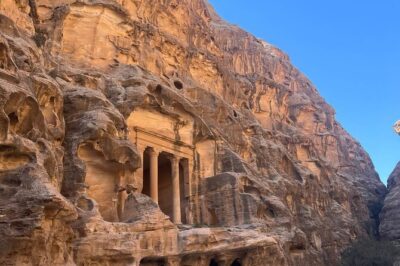
3-Day Private Tour from Amman: Petra, Wadi Rum, Dana, Aqaba, and Dead Sea
Read our review →